Key points
- “Come back if it gets worse” is incomplete unless worse is defined.
- Every watch plan needs five elements: the condition, a baseline, a date, the repeated test and the action triggers.
- Sleep loss, leakage, sexual problems, pain and limits on daily life are legitimate reasons to treat.
- Planned escalation leaves time to compare options; urgent escalation may need the nearest emergency pathway.
- Treatment intensity can and should fall when risk falls or burden exceeds benefit.
- “Can wait” does not mean “does not matter.”
A decision changes when risk or function changes
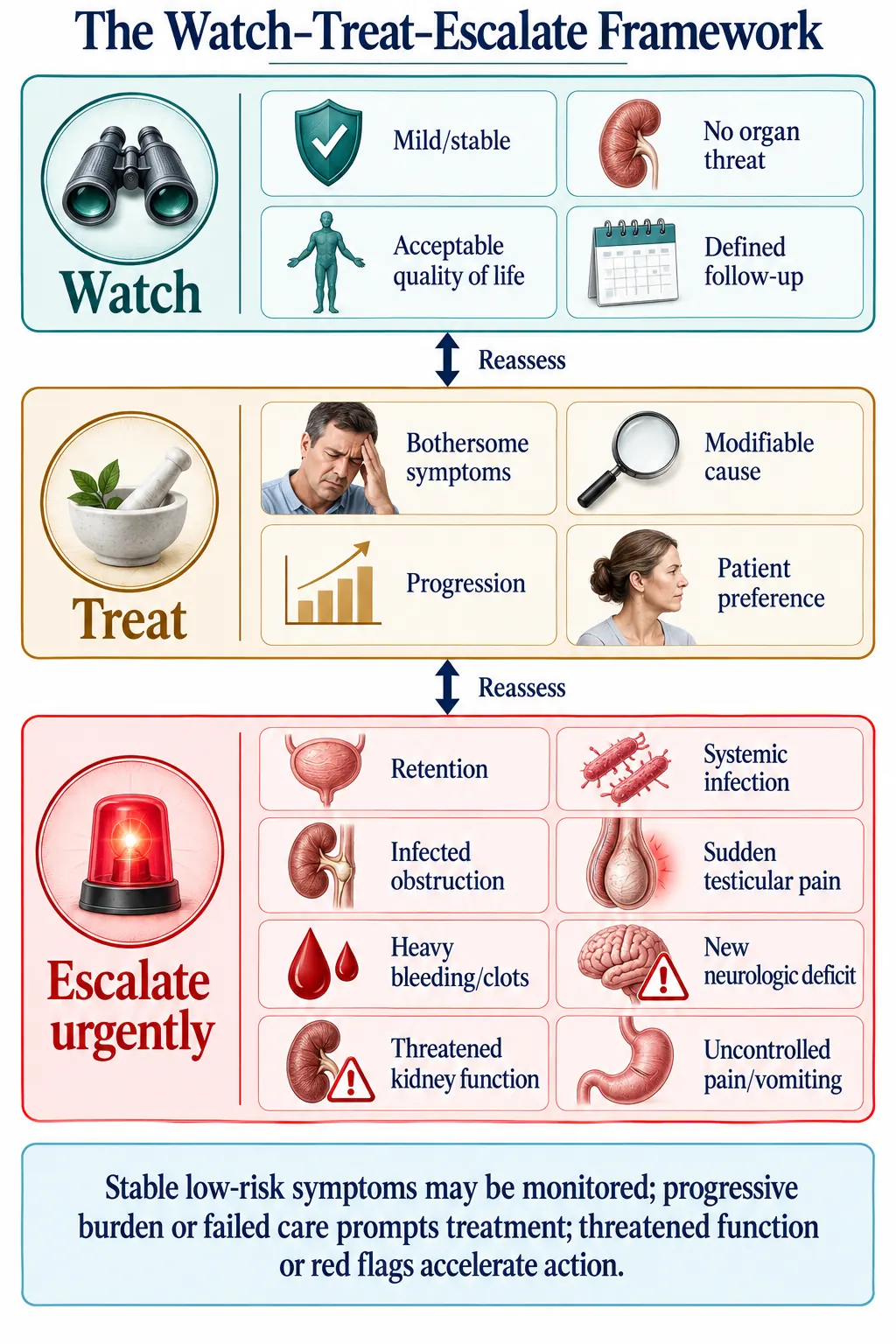
Watching is a plan only when you know what is being watched, how it will be measured and what will trigger action. Watching, treating and escalating are not permanent labels attached to a diagnosis. They are positions that can change when your symptoms, objective measurements, risk to an organ, the burden of treatment or your priorities change.
In broad terms, stable, low-risk symptoms may be monitored. Progressive burden or care that has not worked prompts treatment. Threatened function or warning signs speed everything up.
When watching is reasonable
Watching fits when symptoms are mild or stable, no organ is threatened, your quality of life is acceptable and a defined follow-up is in place. It always needs a baseline and an interval. What that looks like depends on the condition. For one, it may mean symptoms plus a measurement of urine left in the bladder. For another, PSA and MRI. For a kidney mass, scheduled imaging. For a stone, confirmation that the blockage has resolved.
Watching means re-measuring, not just waiting. With a stone, for example, pain can settle while a blockage persists, so the plan confirms drainage rather than waiting for pain to stop. With surveillance of a PSA or a kidney finding, the plan defines in advance which lab or imaging change prompts reassessment. If you cannot say what would count as “worse,” the plan is not finished yet.
Every watch plan needs five elements
- The condition or uncertainty being watched, named clearly.
- The baseline: the symptom, lab value, image or functional measurement as it stands today.
- The next follow-up date.
- The test or observation that will be repeated.
- The triggers: the findings that would move you from watching to treatment, or to urgent care.
These elements turn reassurance into surveillance. They prevent two common errors: repeating tests indefinitely without any decision threshold, and losing follow-up because neither you nor your clinician knew who was responsible. Watching is safe only when somebody owns the plan.
Treatment is justified by burden, not only danger
You do not need to be in danger to deserve treatment. Sleep loss, leakage, sexual dysfunction, pain and restriction of daily life are legitimate reasons to act. Treatment also makes sense when there is a cause that can be modified, when a condition is progressing, or simply when you prefer to treat after understanding the options. Whatever the reason, treatment comes with its own reassessment point: what improvement is expected, by when, which side effects would end it and what the next step would be if the target is not met. A treatment that continues for years without anyone checking whether it still helps has drifted out of the plan.
Planned escalation and urgent escalation are different
Planned escalation happens when symptoms remain burdensome, objective function worsens, medication is intolerable, or surveillance crosses a threshold set in advance. There is time to compare options, seek another opinion, prepare for recovery and protect your personal priorities.
Urgent escalation is another matter. Infected obstruction, inability to urinate, threatened blood flow to a testicle, heavy bleeding with clots, rapidly worsening kidney function, new neurologic deficits or general instability may need the nearest appropriate emergency pathway, rather than waiting for your preferred long-term specialist.
Knowing the difference works in both directions. It keeps fear from making every decision feel immediate, and it keeps convenience from delaying a decision that is genuinely time-sensitive.
Improvement can justify stepping down
Treatment intensity should fall when risk falls or when burden exceeds benefit. A trigger that has resolved may allow a medication to be reduced. Frailty or other illness may make invasive surveillance less useful. A symptom controlled through behavioral or tissue treatment may no longer justify a planned procedure.
Stepping down should be just as deliberate as stepping up, with the same baseline, follow-up and warning signs. Doing less can be excellent medicine when the reason is explicit.
“Can wait” is not “does not matter”
Many important problems can be evaluated methodically and safely over weeks. That is different from saying they do not matter. You deserve a timeline and clear trigger points, not vague reassurance. Before leaving a visit where observation is recommended, make sure you can say what is being watched, when it will be measured again and which finding would end observation and prompt treatment.
Questions to ask your urologist
- What exactly is being watched in my case?
- How and when will it be measured again, and who will arrange that?
- Which finding would end observation and prompt treatment?
- Which symptoms mean I should seek urgent care rather than wait for my next visit?
- If my symptoms improve, could my treatment be reduced?