Key points
- Define success, and how it will be measured, before comparing treatment intensity.
- Avoiding a more invasive treatment is a real benefit when safety and future options are preserved.
- A trial needs a defined duration and reassessment point; a trial that runs for years is no longer a trial.
- Cost includes time, travel, missed work, caregiving, supplies, monitoring and retreatment, not just price.
- Outcomes depend on the clinician, the team and follow-up, not only on the drug, device or operation.
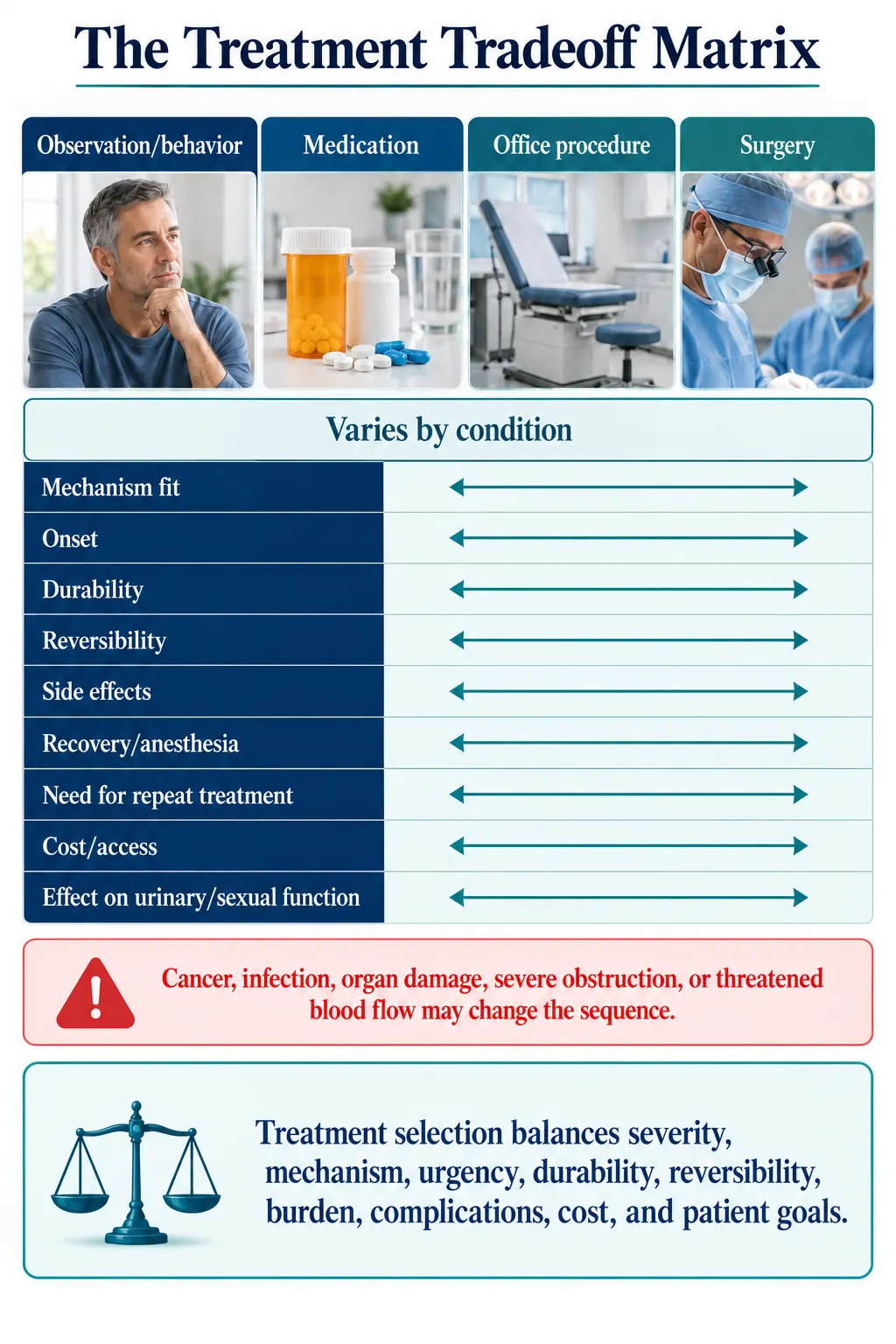
- Cancer, infection, organ damage, severe obstruction or threatened blood flow may change the usual sequence.
Escalation is a tradeoff, not a failure
The least invasive option is not always the safest, and the most durable option is not always the best fit. Each level of treatment buys something and costs something.
- Observation and behavior change carry little immediate risk but depend on effort and time.
- Medication may offer reversibility and low immediate burden, while requiring daily adherence and accepting side effects.
- An office procedure may reduce dependence on medication and shorten recovery, but may offer less durability or suit a narrower range of anatomy.
- Surgery may correct anatomy more completely, while carrying anesthesia, recovery and effects on function.
Comparing them means looking at several things at once: how well the option fits the mechanism, how soon it works, how long it lasts, whether it can be reversed, its side effects, recovery and anesthesia, the chance of repeat treatment, cost and access, and its effect on urinary and sexual function.
Define the goal before comparing treatments
A treatment cannot be chosen intelligently until success is named. The goal might be better sleep, fewer infections, kidney protection or less retention. It might be continence, preserved ejaculation, reliable erections, cancer control, less medication or pain relief. One treatment may serve several goals, but it rarely optimizes all of them.
The starting point and the target should be measurable. A symptom diary, residual urine, flow, how often infections recur, pad use, erection reliability, an imaging finding, a lab trend or a daily activity may serve as the measure. Without a baseline, a modest benefit can be overlooked, and an ineffective treatment can continue indefinitely.
When escalation makes sense
Moving to a more intensive option becomes rational when symptoms remain unacceptable or medication causes too much burden. Objective damage, recurrent retention or infection, and anatomy unlikely to respond to conservative care also support escalation. You may also simply prefer a more definitive option after informed consent. Cancer, infection, organ damage, severe obstruction or threatened blood flow can change the usual order altogether.
Stepping down is equally legitimate. When risk is low and the burden of treatment exceeds its likely benefit, doing less is good medicine.
A trial does not mean drift
Conservative care and medication deserve a defined duration and a reassessment plan. You should know what improvement to expect and when it should appear, which side effects would end the trial and what happens next if the target is not met. A trial that continues for years without reassessment is no longer a trial.
Procedures and surgery need the same discipline. Ask how soon benefit should appear, whether temporary worsening is expected, what follow-up measurement will confirm success and how retreatment or a rescue procedure would be handled. Escalation makes sense when the original goal still matters and the next option offers a better balance of benefit and burden.
Cost is more than price
The true cost of a treatment includes time, travel, missed work, caregiver needs, supplies, monitoring, retreatment and any rehabilitation that follows. Those burdens differ widely between options and between people, and they belong in the comparison.
The clinician and the system are part of the treatment
Outcomes depend not only on the medication, device or operation but on patient selection, technique, anesthesia, infection prevention, after-hours coverage, catheter care, rehabilitation and follow-up. Experience with your exact anatomy and procedure matters more than a general claim of expertise. Physician experience and local availability also shape what is recommended, so you should know when a reasonable alternative would require a referral.
You may reasonably travel for a complex operation while preferring follow-up close to home. That requires explicit coordination. The best option on paper can become the wrong practical choice if postoperative support is out of reach or you cannot manage the recovery safely.
Three people, three reasonable choices
One person has mild symptoms, no threat to any organ and little burden; observation with a defined follow-up plan may be best. A second wants a reversible treatment and accepts daily medication. A third has repeated retention, poor emptying or anatomy unlikely to respond to medication, and chooses a procedure after reviewing the risks. These choices are not a ladder of courage. They reflect different mechanisms, risks, goals and time horizons.
Three revealing questions
What happens if we wait? What happens if the treatment fails? Which side effect would matter most to me? Together these reveal the urgency, the fallback options and your values. The decision improves when you can state what success means and what burden would make an option unacceptable. A more invasive treatment can be the right choice when it fits those answers.
Questions to ask your urologist
- What would success look like for me, and how will we measure it?
- How do the options compare for burden, durability, reversibility and recovery?
- What happens if we wait, and what happens if this treatment fails?
- Which side effect would matter most, and how likely is it with each option?
- Is there a reasonable less invasive or more definitive alternative we have not discussed?
- Would any option require a referral to another specialist?