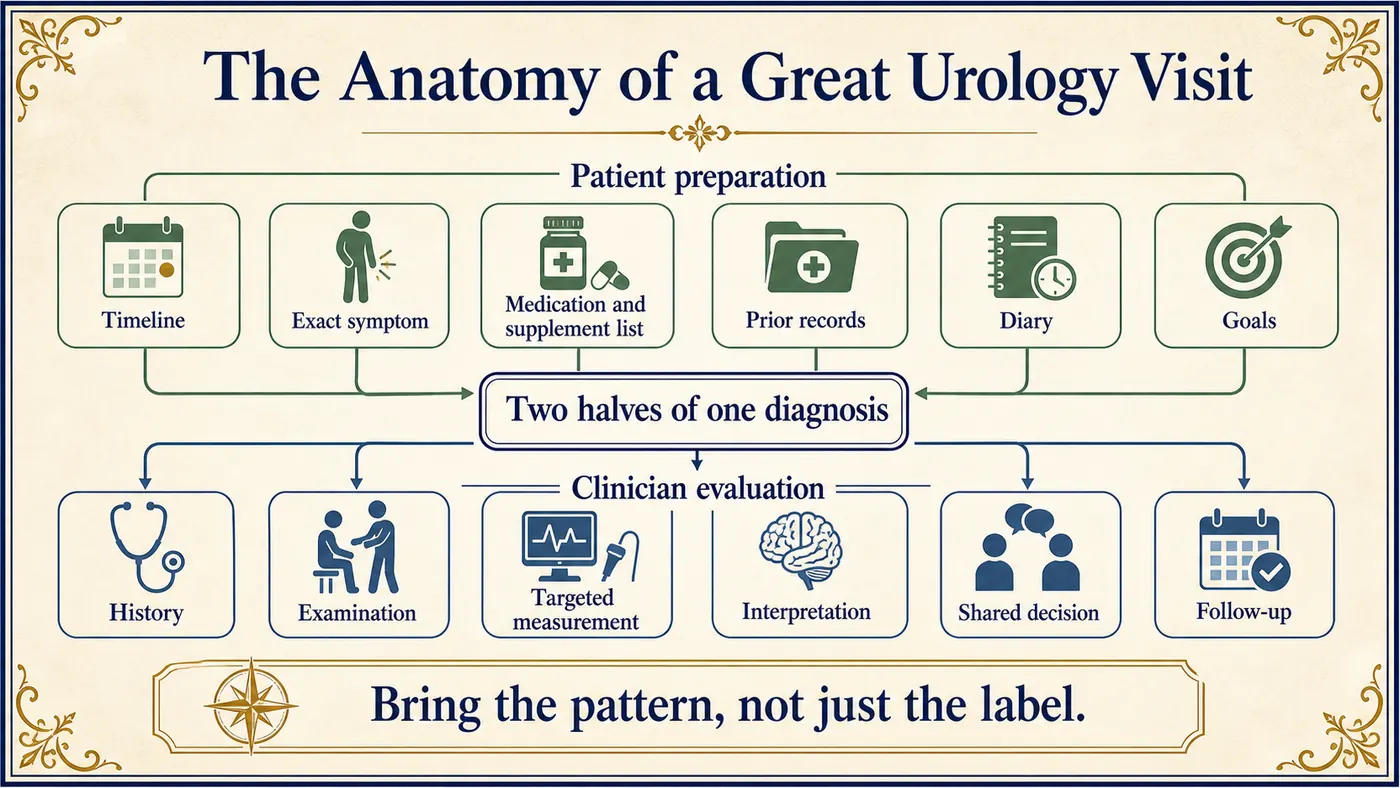
Key points
- Open with your main concern so it is not lost at the end of the visit.
- Timing and pattern are often more revealing than severity.
- Bring every prescription, over-the-counter medicine, supplement and hormone you take.
- A two- or three-day bladder diary can be more useful than an early scan.
- Sexual symptoms are medical topics; mention them even if you are not asked.
- Every test should answer a question that could change your treatment.
Bring an organized story
The quality of a consultation depends not only on what the physician knows, but on how clearly your story can be understood. “I urinate all the time” matters, but it does not yet say what is wrong. Does that mean every thirty minutes or every two hours? Are the amounts small or large? Is it daytime, nighttime or both? Is there urgency, leakage, pain, weak flow, thirst, leg swelling or poor sleep? Did it begin suddenly or over years?
A careful history often narrows the possibilities before any test is ordered. It is not a formality before the “real” medicine; it is where the real medicine begins. Preparation does not mean diagnosing yourself. It means making the clinical picture easier to see.
Start with the main problem
One of the most common failures in medical visits is that the most important concern appears only at the end. Someone may spend most of the visit on mild frequency and then mention visible blood in the urine as the appointment closes. A useful opening sentence is: “The main reason I came today is…” If several problems are present, rank them. Which is newest? Which is worsening? Which affects your life most? Which are you most afraid may be serious?
Build a timeline and describe it precisely
“I have had this for a while” is less useful than “It began six months ago, was intermittent for three months, and became daily after I started a new medication.” Note when it began, whether the onset was sudden or gradual, whether it is stable, improving or worsening, and what happened around that time: a new medication, surgery, infection, sexual exposure, injury, childbirth or severe stress. Note what has been tried and what changed. A mild but new symptom may deserve more attention than a severe one unchanged for years.
You do not need medical terms, but you do need specificity. Describe the color, odor, sediment, blood or foam of your urine. Say where pain is felt, whether it is sharp or dull, and whether it comes with urination, ejaculation, movement or rest. For erections, say whether the problem is achieving, maintaining, rigidity, morning erections, libido, orgasm, ejaculation, pain or curvature. For leakage, say whether it happens with urgency, coughing, exercise, standing, sleep or without awareness.
Bring a complete medication list
Include prescription and over-the-counter medications, supplements, hormones, injections and recreational substances, with doses and how often you take them. Diuretics increase urine production. Some antihistamines and decongestants can worsen emptying. Certain antidepressants can affect libido, erection, orgasm or ejaculation. Opioids can influence hormones and bladder function. Supplements can affect bleeding, blood pressure, hormones and drug interactions; “natural” does not mean clinically irrelevant. Do not stop an important medication because you suspect it, but bring the concern to the physician who can discuss alternatives.
Bring the records that matter
Bring relevant urine tests and cultures, kidney-function results, PSA values over time, hormone results, imaging reports and, when available, the images themselves, along with pathology, operative, cystoscopy and urodynamic reports. A single result is often less useful than a sequence. A folder of hundreds of pages can hide the useful result, so identify the key reports, dates and trends.
- Procedures: prostate, pelvic, hernia, gynecologic, spinal, colorectal or bladder surgery, urethral dilation, catheterization, radiation, stone procedures and cancer treatment. If you don’t know the name, give the year, hospital and reason.
- Infections: the date, symptoms, organism, antibiotic and whether symptoms fully resolved for each episode, with culture results when possible.
- Stones: prior imaging, stone analysis, twenty-four-hour urine studies, which side, and whether stones passed, needed surgery or recurred.
- Family history: which relative had which condition, and at what age. A father diagnosed with prostate cancer at eighty-five means something different from a brother diagnosed at fifty.
Keep a bladder diary
For frequency, urgency, leakage or nighttime urination, record two or three typical days: when you drink and roughly how much, the time and approximate volume of each urination, episodes of urgency or leakage and what you were doing, and your bedtime, wake time and nighttime voids. The diary can distinguish small, frequent voids from high urine production and can show patterns after coffee, alcohol, exercise or a diuretic dose. It cannot measure urine left in the bladder; that needs a post-void residual. Remembered and recorded patterns often differ, and that is not a failure.
Symptom questionnaires do not diagnose disease, but they measure burden and set a baseline. Answer honestly, neither minimizing nor exaggerating.
Talk about sexual health and daily life
Erections, ejaculation, orgasm, libido, fertility, curvature, sensation and pain are medical topics. Embarrassment removes information from the diagnosis; it does not remove the symptom. Fertility concerns need detail on how long you have been trying, prior pregnancies, semen testing, childhood testicular problems, surgery and testosterone use. Fluids, caffeine, alcohol, smoking, diet, activity, constipation, sleep, weight change and stress may all matter. The goal is not blame but finding what can be changed.
Testing and decisions
A good consultation does not always produce the longest test list. Your physician should be able to explain what each test is meant to answer and what will change depending on the result. Once the diagnosis is clearer, treatment should be chosen together: the physician explains reasonable options, benefits, risks, recovery and the effects of observation, and you contribute your priorities, whether that is avoiding sexual side effects, rapid relief or the least invasive approach. A trusted companion can help when memory, anxiety or complex decisions are involved.
Leave with a clear plan
Before leaving, know the working diagnosis and what remains uncertain, which tests are ordered and why, what treatment starts now, which medications continue or change, when results will be reviewed, and which symptoms require urgent contact. If you cannot explain the next step in your own words, the plan may not be clear enough.
Questions to ask your urologist
- What do you think is most likely causing my symptom, and what alternatives remain?
- Is there anything dangerous that needs to be excluded?
- Why are you ordering this test, and what will we do differently depending on the result?
- What happens if I choose observation?
- How will we know whether treatment is working?
- When should I contact you sooner, and who will contact me with results?