Key points
- The goal is a short dashboard of priorities, not a shopping list of biomarkers.
- Testosterone is measured when symptoms and context justify it, not as a universal wellness screen.
- Cancer screening is tailored to organ, age, inherited risk, health, life expectancy and willingness to act.
- Near-term threats come first, then modifiable risks, then optimizations.
- Each domain needs its own timing; an annual “longevity panel” can blur those differences.
- A plan only works if you can access, afford and carry it out.
Measure the systems that protect function
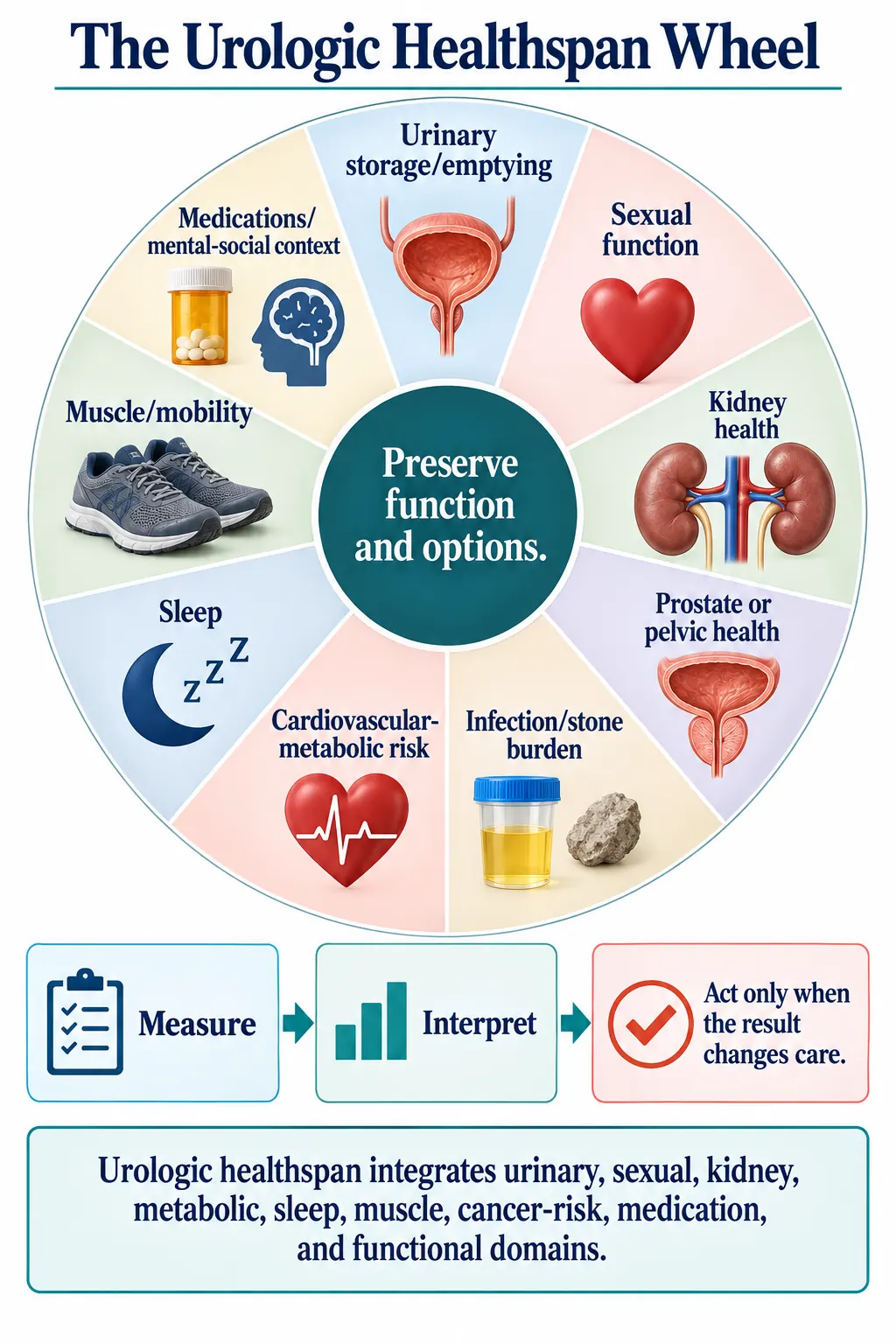
A healthspan assessment is not a shopping list of biomarkers. It is a structured review of the risks and functions that can change a clinical decision. It is useful only if it turns a broad idea such as healthy aging into measurements and decisions, connecting urinary, sexual, kidney, metabolic, mobility and cognitive signals without pretending that any one score can predict a life.
Think of it as a wheel with several connected domains: urinary storage and emptying, sexual function, kidney health, prostate or pelvic health, infection and stone history, cardiovascular and metabolic risk, sleep, muscle and mobility, and medications along with your mental and social context. The aim across all of them is the same: preserve function and options.
What the assessment includes
It begins with history and function: urinary symptoms, continence, risk of retention, sexual changes, stones, infections, cancer history, medications, sleep, exercise, strength, falls and your goals. Measurements may include blood pressure, waist size or body composition when useful, glucose or A1c, cholesterol, kidney function, protein in the urine and condition-specific urologic tests.
Testosterone is measured when symptoms and context justify it, not as a universal wellness screen. Cancer screening is tailored to the organ, your age, inherited risk, health, life expectancy and willingness to act on results. More imaging and more biomarkers do not always create more health. Incidental findings and false positives have consequences of their own.
Turn findings into a ranked problem list
- First tier: near-term threats. Infected obstruction, retention affecting the kidneys, significant bleeding, a concerning mass, unstable heart symptoms or rapid functional decline.
- Second tier: modifiable progressive risks. Blood pressure, diabetes, smoking, sleep apnea, recurrent stones, medication burden and loss of strength.
- Third tier: preferences and optimizations. These matter, but they do not displace urgent disease.
Ranking keeps a mildly abnormal biomarker from getting more attention than a dangerous symptom. It also makes the plan understandable. You should leave knowing your first two or three actions, not holding an undifferentiated catalogue of risks.
Use a cadence, not a testing spree
Different domains change on different time scales. Blood pressure may need repeated home readings. Glucose and cholesterol follow metabolic treatment. Kidney function may need a short-interval recheck after an obstruction or a medication change, and longer intervals once stable. Cancer screening follows its own risk-based schedule. Strength and symptoms can be tracked through everyday function.
Bundling every test into a yearly “longevity panel” can hide these differences. A cadence assigns each measurement an owner and a timing based on the clinical question. It also defines when a test can stop, because it no longer changes care.
Include your capacity to act
A recommendation is useful only if you can access, understand and carry it out. Cost, transportation, caregiving, language, health literacy, work and trust all shape what is realistic. A good assessment raises these constraints openly instead of documenting “nonadherence” after an unrealistic plan fails.
Define the outcome you could not accept
Quality of life is a medical outcome. Before choosing among treatments, it often helps to name what you could not accept: permanent catheter dependence, uncontrolled cancer risk, severe leakage, loss of independent living, repeated hospital stays, pain or a particular sexual consequence. The answer does not dictate treatment, but it shows which risks deserve the most weight.
Goals can conflict. The most durable operation may need a recovery you cannot manage. A medication may preserve independence while raising fall risk. Avoiding a catheter at all costs may be less safe than temporary drainage. Shared decisions become real when these conflicts are stated openly. Planning ahead matters too: ask what function is most important, how much recovery burden is acceptable, who can help at home and what outcome would feel worse than the disease itself.
Reassess as life changes
A plan that suited you at sixty may become burdensome at eighty-five. A caregiver may become unavailable; cognition, dexterity, mobility and tolerance for procedures may change. Devices and medications should not continue indefinitely just because they once solved a problem. Reducing burden can be an active medical achievement when it preserves safety, comfort and independence.
From dashboard to care plan
The assessment should end with priorities, not pages of abnormal values. Which threat is most actionable? Which function is deteriorating? Which treatment protects several systems at once? Which test would only create noise? Answering those questions is how a dashboard becomes a care plan, aimed at staying independent, continent, intimate, mobile and engaged in the life you value.
Questions to ask your urologist
- Which functions is my plan intended to preserve?
- Which measurements can lead to useful action, and which would only add noise?
- What are my top two or three priorities right now?
- How often should each measurement be repeated, and when can a test stop?
- Who is responsible for each follow-up step?
- Can I realistically carry out this plan, and what support would help?