Key points
- A plan is more than a list of diagnoses; it is built around the next decision.
- Write tests as questions: “repeat residual to confirm safe emptying,” not just “residual.”
- Every action needs a person and a date, and a plan for what happens if no one calls.
- Warning signs should be specific to your condition while keeping universal red flags.
- Date each version and keep source reports separately; protect the page’s privacy.
- The plan belongs to you but is built with clinicians; it never replaces urgent care.
Turn information into the next right action
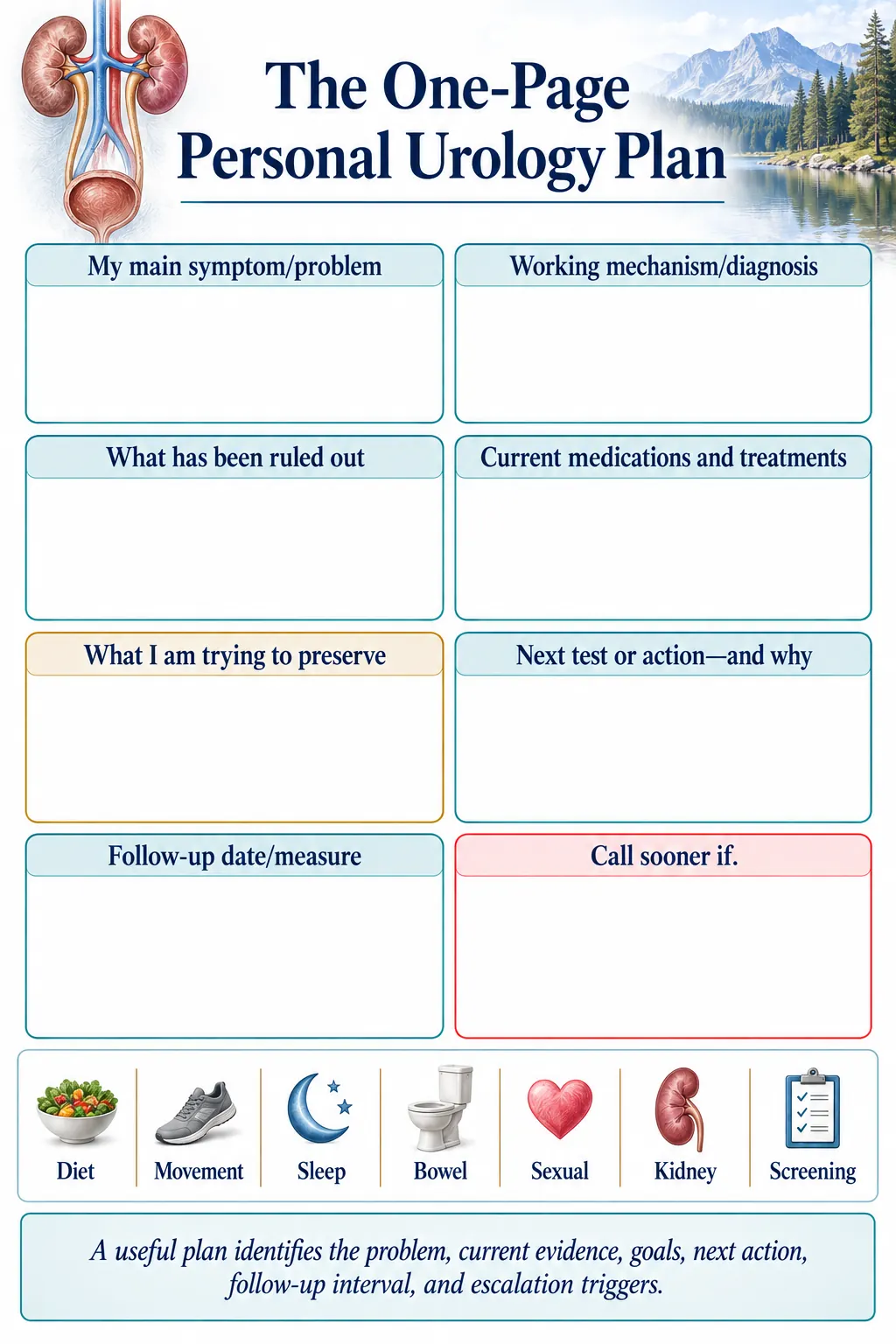
A personal plan is more than a list of diagnoses. It connects each problem to the mechanism being tested, the function you are trying to preserve, the next action, the person responsible and the date on which the loop will close. It should fit on one page well enough to guide the next visit, while staying flexible enough to change when the evidence changes.
The point is not to make you your own urologist. It is to make you a more informed historian, observer and decision partner. A one-page plan is where that partnership becomes visible.
What goes on the page
- Your main concern, in one sentence.
- The working diagnosis or mechanism, and the uncertainty that remains.
- What has been ruled out, and which dangerous conditions are still being evaluated.
- Current medications and treatments, each with its reason and any important side effect, plus prior procedures.
- What you are trying to preserve: the outcome you value most.
- The next test or action, and why: the exact question it is meant to answer.
- The follow-up date and measure: the test, symptom diary or functional measure that will show whether the approach is working.
- Call sooner if: the warning signs that should prompt earlier contact.
Include the relevant whole-health work too, such as diet, movement, sleep, bowel function, sexual health, kidney health and screening, or blood pressure, glucose, smoking, weight and medication review. Keep it realistic rather than turning the page into an impossible overhaul.
Build the page around decisions
The page should not reproduce your entire medical record. It should hold the information that changes the next decision: the main problem, the working mechanism, what has been excluded or is still under evaluation, current treatment, the relevant baseline, the outcome you want, the next action and the follow-up trigger.
Write tests as questions, not just names. “MRI to decide whether biopsy is still necessary” is more useful than “MRI ordered.” “Repeat residual after medication change to confirm safe emptying” preserves the reasoning, so anyone reading the page later understands why the step matters.
Add ownership and timing
Every action needs a person and a date. Who orders the culture, reviews the pathology, follows the PSA, removes the catheter or repeats the scan? When should you expect the result, and what should happen if no one calls? A good plan can fail simply because nobody owns the follow-up.
Make the warning signs specific
The “call sooner” section should fit your condition while keeping universal red flags. A stone plan may emphasize fever, vomiting, reduced urine and uncontrolled pain. A plan after a procedure may emphasize heavy bleeding, inability to urinate, a change in the wound or shortness of breath. A cancer-surveillance plan may instead define the lab or imaging change that prompts reassessment rather than emergency care.
Keep a living version
Update the page after a new diagnosis, a procedure, an important test, a medication change or a shift in your goals. Date each version so an old plan is not mistaken for current instructions. Keep the source reports separately; the one-page plan points to them but does not replace them.
Privacy matters. The page holds sexual, urinary, medication and cancer information you may not want visible on an unlocked phone or a shared family account. Balance convenience with secure storage and deliberate sharing.
What the plan is not
The plan belongs to you, but it is built with your clinicians. It is not permission to interpret serious symptoms on your own, change prescriptions independently or delay urgent care. The warning signs on the page should always override the routine schedule.
End with the next right action
Learning a lot about urologic health can create the temptation to solve everything at once. A personal plan does the opposite. It identifies the next right action and the reason it comes before the others. Once that step is done, the evidence is reviewed and the plan moves forward. That sequence turns knowledge into care without asking you to become the clinician.
Before you leave any visit, make sure you can name the next action, the person responsible and the date it should happen, which result would change the plan and which symptom means you should seek care before the scheduled follow-up. Good urologic care is not a single appointment or procedure. It is a sequence of observations, measurements, decisions and reassessments designed to preserve your health and function over time.
Questions to ask your urologist
- What is my working diagnosis, and what uncertainty remains?
- What is the next action, and what question will it answer?
- Who is responsible for arranging it, and by when?
- Which result would change the plan?
- Which symptoms mean I should seek care before my scheduled follow-up?