Key points
- Burning is a symptom of irritated tissue; the diagnosis depends on what is causing the irritation.
- When burning happens during urination (at the start, throughout, at the end or afterward) is a clue to where it comes from.
- In a stable person with recurring burning, a properly collected culture before another antibiotic can be one of the most valuable steps.
- A negative culture does not mean the pain is imagined; it means bacteria are a less convincing explanation.
- In women after menopause, thinner, more fragile tissue is a common non-bacterial cause of chronic burning.
- Treating the wrong disease well is still the wrong treatment.
Burning does not always mean infection
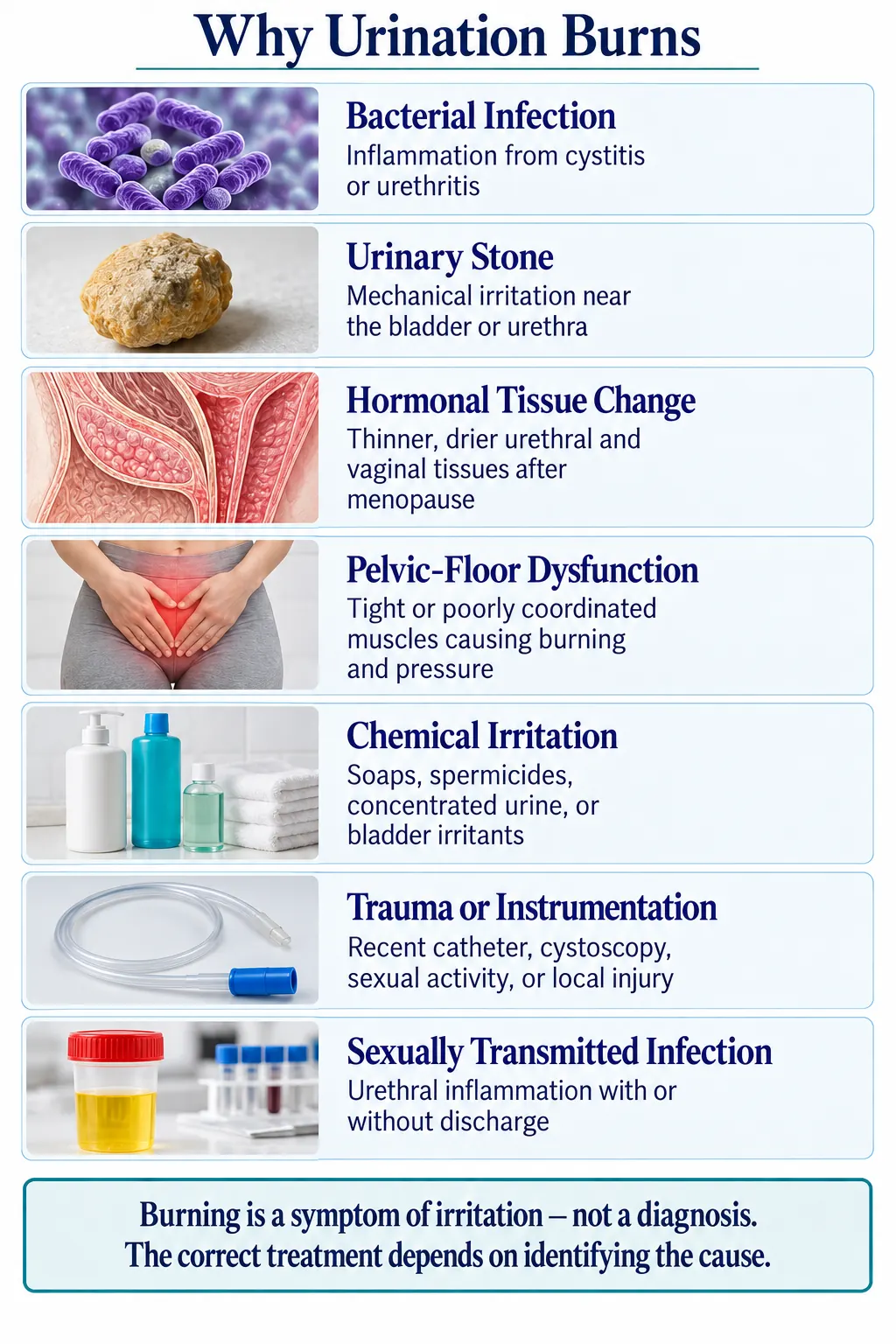
Burning when you urinate feels so typical of infection that many people, and sometimes clinicians, treat the diagnosis as already made. Some people arrive with a folder of prescriptions: six antibiotic courses in eight months, each bringing brief relief or none at all. The pain is real. But burning, called dysuria, is a symptom. It tells you that tissue somewhere along the urinary tract is irritated. It does not tell you why.
Pain has a timeline and a geography
The kidneys, ureters, bladder, prostate, urethra, pelvic floor and surrounding tissues all contain pain-sensitive structures. Burning at the start of urination may point to a different source than burning throughout the stream, pain that peaks as the bladder empties, or discomfort that lingers afterward. A stone may cause pain that spreads toward the groin before any burning. Pelvic-floor spasm can cause burning even when the bladder is normal. Describe it in your own words: does it sting, burn, ache or feel raw? Is it better after you void, or worse with a full bladder? Those details are physiologic clues.
Common causes that are not bacterial
Pelvic-floor tension. When the muscles that support the pelvic organs and coordinate urination become chronically tight or poorly coordinated, they can cause burning, pressure, urgency, incomplete emptying, pain with intercourse or discomfort after voiding. It closely resembles infection. A careful examination may change the plan more than another lab test.
Menopause-related tissue change. As estrogen declines, the tissues around the urethra and vagina become thinner, less elastic and more easily irritated. Many women are told they keep getting infections, yet when the cultures are reviewed, many are negative. The symptoms were real; the diagnosis was not infection. Recognizing this pattern prevents repeated unnecessary antibiotics and directs treatment toward the tissue itself.
Stones. A small stone near the lower ureter or bladder can cause burning, urgency, frequency, pressure and sometimes visible blood. The right treatment is not another antibiotic. It is finding and managing the stone.
Other possibilities include sexually transmitted infection, chemical irritation from soaps, spermicides or concentrated urine, and irritation after a catheter, cystoscopy, sexual activity or injury. Context changes the odds: burning after a catheter, after unprotected sex, after pelvic radiation, with diabetes or after a kidney transplant each calls for a different evaluation.
Why the culture matters more than another antibiotic
A urinalysis gives clues: blood, inflammation, white cells, nitrites, glucose, protein, crystals, concentrated urine. A urine culture answers a different question: are bacteria growing, and which antibiotics are likely to work? Treating a culture-confirmed infection is very different from treating burning when cultures keep coming back negative.
If you have fever, flank pain or signs of serious infection, treatment may need to start right away while the culture is pending. But if you are stable and the burning keeps returning, getting a properly collected culture before the next antibiotic can be one of the most valuable steps you take. Antibiotics change the evidence; once treatment starts, the culture may no longer show what was there.
Feeling better after an antibiotic does not always prove infection. Some symptoms improve with time or because you drank more while taking the pills. Without confirmation, coincidence can be mistaken for cure, and every unnecessary antibiotic changes your bacteria, affects future cultures, raises resistance risk and adds side effects.
Examination and further tests
The examination follows the complaint. A woman with burning, urgency and negative cultures may benefit from a pelvic examination to look for tissue changes, pelvic-floor tenderness, prolapse or discharge. A man with burning and difficulty urinating may need an abdominal and genital examination and, when appropriate, a prostate examination as one part of the picture.
Most people with uncomplicated burning do not need imaging. Ultrasound or CT becomes useful with persistent blood, recurrent infection, suspected stones, severe flank pain, obstruction or unusual findings. Cystoscopy, a direct look at the urethra and bladder, may reveal narrowing, chronic inflammation, a stone, a tumor or a change from prior surgery. Each test should answer a specific question.
When burning is an emergency
Most burning does not need emergency care. Burning with high fever, shaking chills, severe flank pain, vomiting, confusion, profound weakness, inability to urinate, heavy bleeding with clots, rapid genital swelling, severe pain or skin changes needs urgent evaluation.
Before your visit
Instead of asking which antibiotic you need, ask what changed. Did the burning start after sex, a new medication, a procedure, menopause or passing a stone? Was there fever, blood, urgency, back pain or a run of negative cultures? Pain also changes behavior: people drink less, avoid intimacy and start to doubt themselves after failed treatments. If one explanation has repeatedly failed, the diagnosis deserves a fresh look.
Questions to ask your urologist
- Do my urinalysis and culture support bacteria as the cause?
- If my cultures are negative, what else are you considering, such as pelvic-floor dysfunction, low-estrogen tissue change or a stone?
- Should we get a culture before I take another antibiotic?
- What question will any further test answer?
- Which warning signs mean I need urgent care?