Key points
- Sudden severe testicular pain should not wait overnight.
- Torsion cannot be dismissed based on age, activity or wishful thinking.
- Pain that resolves before an exam can still be intermittent torsion; recurrent sudden one-sided attacks deserve prompt assessment.
- A new firm lump in the testicle needs prompt examination and ultrasound even if it is painless.
- A normal ultrasound reassures about blood flow and masses but does not rule out nerve, muscle, spine, hip or pelvic-floor causes.
- Removing the testicle is rarely an appropriate first response to chronic pain.
When time matters most
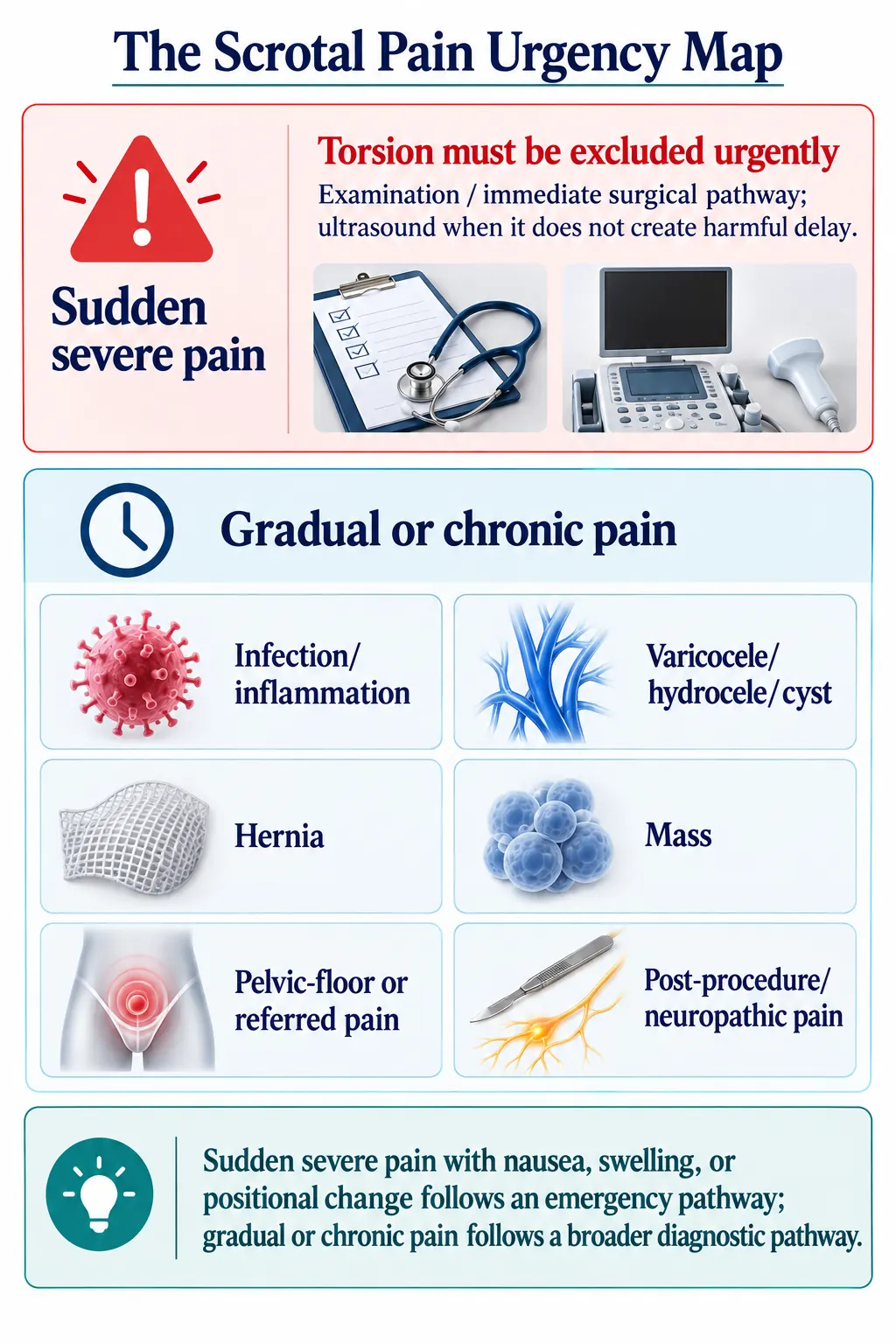
A teenager wakes with sudden testicular pain and nausea, and the family wonders whether he pulled a muscle and could wait until morning. That is the situation in which time matters most. Testicular torsion happens when the spermatic cord twists and blood flow to the testicle is compromised. The pain may be sudden and severe, with swelling, vomiting, abdominal pain or a testicle sitting in an unusual position. The goal is not just pain relief. It is saving tissue before prolonged loss of blood flow causes irreversible injury.
Sudden severe scrotal pain needs emergency assessment even without nausea, swelling or a change in testicular position. None of the clues, including exact onset, nausea, swelling, position, trauma, urinary symptoms, fever or age, is reliable enough to make sudden severe pain safe to watch at home. A Doppler ultrasound can check blood flow when it can be done promptly and the diagnosis is uncertain, but when suspicion of torsion is high, imaging should never delay surgical care.
Torsion can also be intermittent: the cord twists and untwists, causing severe pain that resolves before anyone examines you. A normal study afterward does not erase a convincing story. Recurrent sudden one-sided attacks deserve prompt urologic assessment, because the next one may not resolve.
Other causes of acute pain
Not every acute pain is torsion. Epididymitis and orchitis, inflammation or infection of the epididymis or testicle, cause tenderness and swelling, often developing more gradually and sometimes with urinary symptoms, discharge, fever, a recent procedure or sexual exposure. Testing and antibiotic choice depend on the likely source; a persistent lump or a poor response deserves a second look rather than endless infection treatment. Trauma, a trapped hernia, torsion of a small testicular appendage and less common vascular or inflammatory conditions can also start abruptly. But torsion is the diagnosis that must not be missed.
A painless lump still matters
A testicular mass may not hurt at all. Any new firm lump within the testicle deserves prompt examination and ultrasound. Cancer is not the usual cause of pain, but the absence of pain should never delay evaluation of a mass.
Chronic pain is a localization problem
Long-standing pain behaves differently. A varicocele, enlarged veins in the scrotum, may cause a dragging ache that worsens with standing. A hydrocele, fluid around the testicle, causes swelling or heaviness more often than severe pain. Epididymal cysts are commonly benign and may or may not explain the symptom. A hernia, kidney stone, hip or spine disease, pelvic-floor tension or nerve injury can refer pain into the scrotum even when the testicle itself is normal.
A useful exercise is to point with one finger to the center of the pain. Is it the testicle, epididymis, cord, groin, skin or perineum, or does it radiate from somewhere else? Does lifting the scrotum help? Do ejaculation, sitting, exercise, lifting, bowel movements or hip motion change it? The history also covers prior surgery, vasectomy, hernia repair and back pain.
What ultrasound can and cannot tell you
Scrotal ultrasound is excellent for blood flow, masses inside the testicle, hydrocele, varicocele and many inflammatory changes. It may also find a small cyst or varicocele that has nothing to do with the pain; an abnormality is not always the cause. A normal ultrasound is not a declaration that nothing is wrong either. It does not measure pelvic-floor tension, irritation of the groin nerves, referred spine or hip pain, or an intermittent twisting event.
Treatment follows the cause
Infection needs proper testing and antibiotic selection. Support, anti-inflammatory measures and activity changes may help selected inflammatory or mechanical problems. Pelvic-floor therapy can help when muscle tension and referred pain dominate. For persistent pain that stays localized to one side after a careful evaluation, a spermatic-cord or nerve block can provide diagnostic information and help predict whether selected denervation surgery might help. A temporary response does not guarantee a permanent result, and surgery should follow careful counseling about persistent pain, numbness and other possible sources.
Removing the testicle is rarely an appropriate first response to chronic pain and does not guarantee relief when the pain comes from nerves or elsewhere. Treating every cyst or varicocele seen on imaging risks operating on an incidental finding. The anatomy, examination and pain pattern should agree before any irreversible procedure.
The fears behind the pain
Scrotal pain often carries unspoken fears about cancer, fertility, sexual function and masculinity, which can lead to constant self-checking, avoiding sex and stopping exercise. A clear explanation of what has been excluded, what remains possible and which changes should prompt a new evaluation is itself part of treatment.
Questions to ask your urologist
- Have torsion, infection, a hernia, a mass and referred pain all been considered?
- Do I need a Doppler ultrasound now?
- Where exactly is my pain coming from, and does the ultrasound finding actually explain it?
- If my pain becomes chronic, how will treatment proceed step by step?
- Which changes should make me come back right away?