Key points
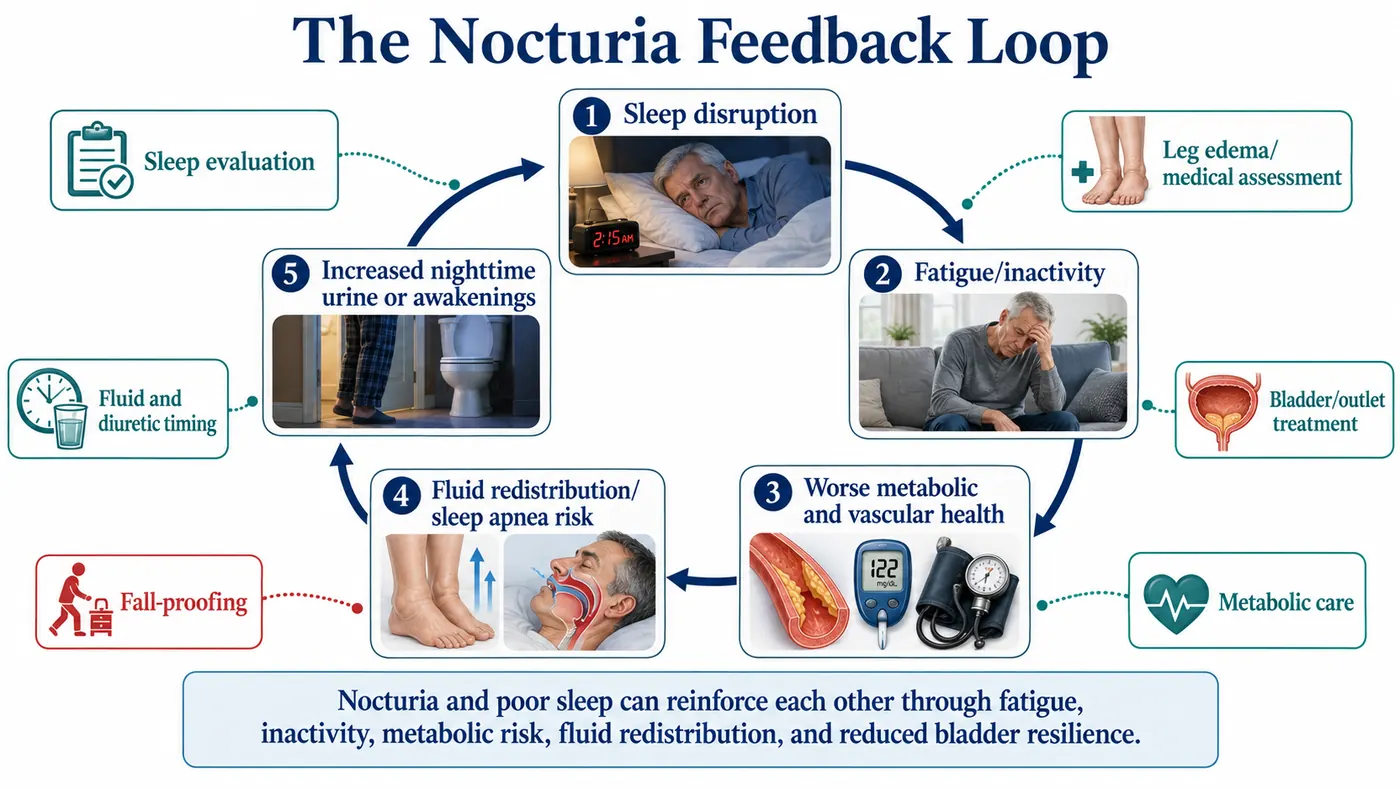
- Nocturia and poor sleep can reinforce each other through fatigue, inactivity, metabolic risk and fluid shifts.
- Large nighttime voids point toward urine production; small voids point toward storage or sleep-first waking.
- A diary shows urine volumes and waking patterns, but incomplete emptying needs a separate residual measurement.
- Treatment may involve sleep medicine, primary care, cardiology, nephrology or a medication review, not only urology.
- Fall prevention is a legitimate part of treatment, starting tonight.
- Treating nocturia does not guarantee preventing heart disease or cognitive decline, but it can reveal treatable conditions.
A nighttime symptom with daytime consequences
Nocturia, waking at night to urinate, belongs to more than the bladder. It also involves the kidneys, the circulation, the sleep system and your daily schedule. It may begin with too much urine made at night, a bladder that stores poorly, incomplete emptying, or sleep that is disrupted for another reason. Whatever starts it, the effects reach well beyond the bathroom.
Repeated awakenings can reduce daytime energy, activity, concentration and balance. Fatigue, mood and metabolic health can all suffer. And the risk of falling rises when an older person moves urgently through a dark room while half awake. Broken sleep is a meaningful health burden, not just an inconvenience.
The feedback loop
Nocturia and poor sleep can feed each other. Sleep disruption brings fatigue and inactivity. Inactivity can worsen metabolic and vascular health. That can contribute to fluid shifting into the legs during the day and to sleep-apnea risk. Fluid returning to the circulation at night and disrupted breathing can then increase nighttime urine or awakenings, which disrupts sleep again. This is a way of thinking about interacting factors, not proof that every link applies to every person. Its value is in showing where the loop can be broken: sleep evaluation, fluid and diuretic timing, assessing leg swelling, bladder treatment, metabolic care and fall-proofing.
Quantify the night before treating it
A frequency-volume diary is the bridge between symptom and mechanism. For several representative days, record:
- bedtime and each awakening
- the volume of each void, including the first one in the morning
- when you drink, and when you take any diuretic
- whether the urge to urinate woke you, or something else did and you went because you were up
The diary can reveal that a large share of your daily urine is made overnight, that you are passing repeated small amounts, or that awakenings come first and urination is only incidental. Large nighttime volumes shift attention toward urine production and fluid redistribution. Small volumes shift attention toward bladder storage and sleep.
The diary does not diagnose sleep apnea, heart failure or a bladder disorder by itself. It tells your clinicians which pathway deserves measurement. It also cannot show whether you empty completely; that needs a separate post-void residual measurement. A high residual changes how safe bladder-directed medication is.
When the pattern points beyond the bladder
Snoring, witnessed pauses in breathing, leg swelling, diabetes, heart or kidney disease, the timing of diuretics, pain and insomnia all widen the plan. Treatment may therefore involve sleep medicine, primary care, cardiology, nephrology or a medication review alongside urology. Adjusting evening fluids can help, but it should not tip into dehydration.
Build a nighttime safety plan now
Treatment can take weeks. A fall can happen tonight. Nighttime urgency combines several risks at once: darkness, grogginess on waking, hurrying and impaired balance. Practical steps reduce that risk immediately:
- motion-activated lighting along the route
- a clear path to the bathroom
- secure footwear
- a stable bedside urinal or commode, when appropriate
- mobility aids within reach
- a review of sedating medications with your clinician
These steps are not giving in to nocturia. They protect you while the cause is being addressed. Falls in older adults are common and preventable, so tell your clinician about any falls or near-falls; they belong in the nocturia history.
Avoid turning association into promise
Nocturia can coexist with sleep apnea, diabetes, vascular disease, swelling, kidney disease and poor sleep. Treating an identified condition may improve both nighttime urination and overall health. But eliminating nocturia does not guarantee prevention of heart disease or cognitive decline, and you should be wary of anyone who promises it does.
The honest message is more useful. Nocturia can reveal a problem that involves several body systems. Fragmented sleep has real consequences for daytime function and safety. And the evaluation should extend beyond the bladder when the pattern points there.
What to do first
The first task is to work out whether urine production, bladder function, emptying or sleep is leading the nighttime event. Start a diary, notice whether the bladder or something else wakes you, look for ankle swelling, ask a partner about snoring or breathing pauses and make your route to the bathroom safe. Effective treatment may require more than a prostate or bladder prescription.
Questions to ask your urologist
- Did the need to urinate wake me, or did I urinate because I was already awake?
- What does my nighttime diary show about volumes and waking patterns?
- Do I need a residual measurement to check whether I empty completely?
- Should sleep apnea, heart, kidney or blood-sugar problems be evaluated?
- Which treatment for sleep, circulation, metabolism or bladder function fits my pattern?
- What can I do now to lower my risk of falling at night?