Key points
- “Low libido” often does not describe the problem; pain, arousal, orgasm or bladder symptoms may be the real limit.
- Desire and arousal are related but not identical, and responsive desire can be normal.
- Pain at the vaginal opening and deep pelvic pain usually have different mechanisms.
- A guarding pelvic floor may need relaxation and coordination, not routine strengthening.
- Medications, sleep, mood, vascular health and diabetes belong in the review; that does not make a symptom “all in your head.”
- Prescription options for low desire, including off-label testosterone after menopause, have narrow, specific roles.
Start by naming what changed
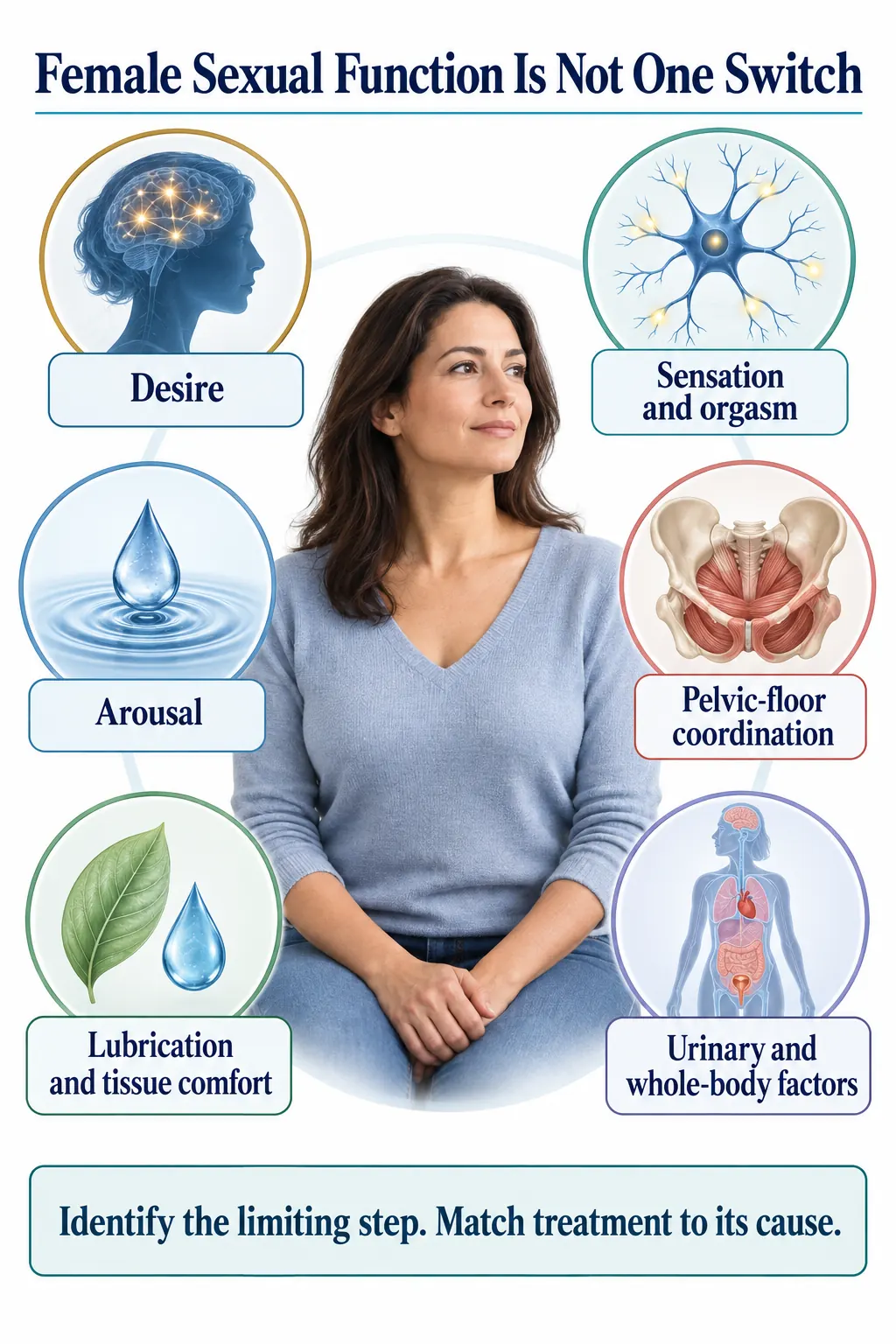
Many women are asked whether they have a “low libido” when that phrase does not describe the problem. One woman still wants intimacy but has pain with penetration. Another has desire but no longer becomes physically aroused. A third becomes aroused but cannot reach orgasm. A fourth avoids sex because urgency, leakage or fear of a urinary infection has made it stressful. These are different clinical problems.
Timing matters too. A gradual change around menopause suggests different causes from sudden pain after a procedure. A problem that began with a new medication deserves a medication review. Naming the specific phase and trigger turns a vague complaint into a useful diagnostic pattern.
Desire and arousal are not identical
Desire is interest in sexual activity. Arousal is the mental and physical response to stimulation. Either can change while the other remains intact. Stress, depression, fatigue, poor sleep, relationship strain, pain, body-image concerns and past trauma can affect desire. Medications, hormonal changes, vascular or neurologic disease, diabetes, pelvic surgery and tissue discomfort can affect physical arousal. Advice to “relax” will not correct painful tissue, and hormones will not solve every desire problem. Responsive desire, in which interest grows after closeness begins, can be normal. The question is whether a change causes you distress, limits a valued relationship or accompanies a medical symptom.
Pain needs a location and a pattern
Pain at the vaginal opening may relate to dryness, fragile tissue, a skin condition, nerve sensitivity, infection or involuntary pelvic-floor tightening. Deeper pain may involve the pelvic-floor muscles, bladder pain, endometriosis, an ovarian or uterine condition, scar tissue or another pelvic source. More than one can be present. Is the pain burning, tearing, pressure or aching? Does it begin with touch, penetration, deeper movement, orgasm, urination or bladder filling? Abnormal bleeding, a lesion, a mass, significant discharge, fever or unexplained progressive pain needs examination rather than repeated self-treatment.
Tissue health and the pelvic floor
The vulva, vagina, urethra, bladder, nerves and pelvic-floor muscles share a small space, so menopause-related tissue change can cause dryness, burning, painful sex, urgency and recurrent urinary symptoms together. Cancer treatment, childbirth, surgery, radiation and skin conditions can also change tissue comfort. Lubricants reduce friction during sex; moisturizers support comfort between encounters; for appropriate women, local tissue-directed hormonal treatment can improve dryness, irritation and some urinary symptoms. That is a different decision from systemic hormone therapy.
Pain can make the pelvic floor tighten in anticipation, and that guarding then becomes part of the problem. This is why routine strengthening is not always the answer. A trained pelvic-floor therapist may first work on breathing, relaxation, coordination, scar mobility, gradual exposure or pain desensitization.
Medications and whole-body health
Antidepressants, blood-pressure medications, sedatives, hormonal therapies and treatments for cancer or chronic pain can affect desire, arousal, lubrication or orgasm. Do not stop a needed medication on your own; ask the prescriber whether timing, dose or substitution is reasonable. Sleep, mood, vascular health, diabetes, pain, relationship context and caregiving stress also matter. Sexual function is a whole-body function.
A respectful evaluation and matched treatment
The visit should begin with permission and a precise history: which function changed, what you want to improve, what examination feels acceptable and whether a partner should be involved. Care may involve a urologist, gynecologist, pelvic-floor therapist, sexual-medicine or menopause specialist, pain specialist or mental-health professional; several systems can contribute. Treatment should target the limiting step: tissue health for dryness, relaxation for pelvic-floor tension, a medication review when a drug interferes, direct bladder treatment when leakage or urgency disrupts intimacy, and counseling or sexual therapy when fear, communication or trauma remains central. Progress is measured in what you value.
When low desire itself needs treatment
Low desire is a clinical concern when it troubles you, not simply because partners differ. Hypoactive sexual desire disorder, or HSDD, describes a persistent desire problem with distress; a testosterone blood result cannot make that diagnosis. Counseling, sexual therapy and treating pain and contributing conditions remain options. Having a medication option does not create an obligation to use it.
- Flibanserin (Addyi) is approved in the United States for certain women younger than 65 with acquired, generalized HSDD, including eligible women after menopause, when the low desire is not explained by another condition, relationship problems or a drug effect. It is taken regularly, not before sex, and can cause sleepiness, dizziness, low blood pressure and fainting. Alcohol timing and drug interactions need explicit instructions, and liver impairment rules it out. The label calls for stopping if symptoms have not improved after eight weeks.
- Bremelanotide (Vyleesi) is an injection used before anticipated sexual activity for selected premenopausal women with acquired, generalized HSDD; it is not approved after menopause. It can cause nausea, temporary blood-pressure elevation and skin darkening that may persist, and uncontrolled high blood pressure or known cardiovascular disease rules it out. Treatment should stop if there is no improvement after eight weeks.
- Testosterone, for a postmenopausal woman with HSDD after full assessment, can offer a modest improvement in desire and distress. In the United States this is off-label, and it is not a treatment for ordinary aging or fatigue. It should be overseen by an experienced clinician, with blood tests used to avoid excess rather than to chase a target. Discuss acne, unwanted hair growth, transfer of skin-applied products and uncertain long-term breast and cardiovascular safety. If there is no meaningful benefit by six months, it should be stopped.
Neither prescription drug is a general sexual-performance enhancer.
Questions to ask your urologist
- Which part of my sexual function seems to be changing: desire, arousal, comfort, orgasm or something else?
- How might tissue health, pelvic-floor tension, urinary symptoms or my medications be contributing?
- Which examination or referral would change the plan?
- Would pelvic-floor therapy focused on relaxation help me?
- If low desire itself is distressing, which treatments fit my diagnosis, and what would prompt us to stop or change them?