Key points
- Genitourinary syndrome of menopause can cause dryness, irritation, burning, painful penetration, urgency and recurrent urinary infection.
- Repeated symptoms with negative cultures should prompt reconsideration rather than automatic antibiotics.
- Local low-dose vaginal estrogen has an important role for many women, with minimal systemic exposure compared with systemic hormone therapy.
- Lubricants, moisturizers and tissue-directed hormones work on different timelines.
- A history of hormone-sensitive cancer calls for coordinated, shared risk assessment, not silence or blanket prohibition.
When tissue change mimics infection
Menopause can affect vaginal and urinary tissues at the same time. Burning, urgency, recurrent urinary symptoms, dryness and painful intercourse after menopause may arise from one shared tissue environment rather than from several separate problems.
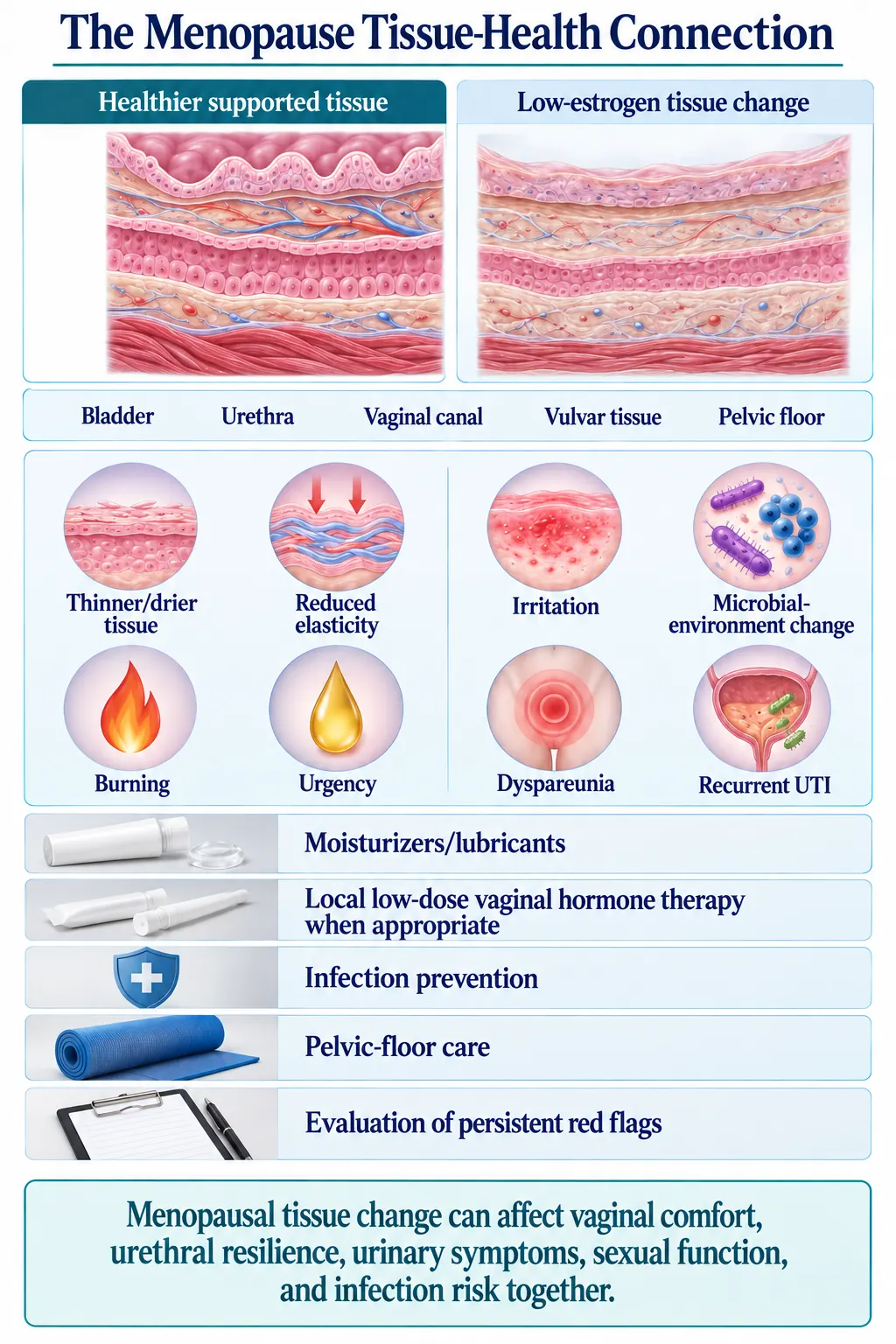
Genitourinary syndrome of menopause, often shortened to GSM, describes changes associated with declining estrogen in the vulva, vagina, urethra and bladder region. Tissue may become thinner, drier, less elastic and more vulnerable to friction and to shifts in the local balance of bacteria. Symptoms can include dryness, irritation, burning, pain with penetration, urgency and recurrent urinary infection. Because these tissues sit so close together, the same change can affect vaginal comfort, the resilience of the urethra, bladder symptoms, sexual function and infection risk all at once.
Diagnosis still needs care
The diagnosis is made clinically, from your symptoms and an examination, but infection and other causes still need appropriate workup. A positive culture supports a bacterial infection. Recurrent symptoms with negative cultures should prompt reconsideration rather than automatic antibiotics.
Some findings change the pathway and need an examination rather than being assumed to be menopause: blood, abnormal bleeding, ulceration or a sore, a mass, a skin change, discharge, persistent pain in one spot, or symptoms with no clear cause.
When negative cultures are a clue
A woman may receive several antibiotic courses for burning and urgency, yet her cultures remain negative. If the symptoms began around menopause and occur alongside dryness or painful sex, the pattern may point toward tissue change rather than repeated bacterial infection. An examination can also identify a skin condition, pelvic-floor tenderness or another source of pain.
That does not mean future infection is impossible. It means each episode should be judged on its own evidence. Treating the tissue problem can reduce discomfort and unnecessary antibiotics, while a new fever, a positive culture, blood or a focal finding can still change the plan.
Treatment options
- Lubricants reduce friction and are used during sexual activity.
- Nonhormonal moisturizers are used regularly to reduce dryness and support everyday comfort.
- Local low-dose vaginal estrogen has an important role for many women with bothersome symptoms and recurrent urinary infection risk. Its systemic exposure is minimal compared with systemic hormone therapy.
- Other local hormonal options may also be considered.
Treatment applied to local tissue is a different choice from hormones that act throughout the body. Individual risk and your preferences should be reviewed with the relevant clinicians rather than handled by blanket prohibition or casual reassurance. A cancer history or unexplained bleeding changes the discussion.
Symptoms improve on different timelines
Lubricants work during sex, while moisturizers support comfort when used regularly. Tissue-directed hormonal treatment generally needs consistent use and time. Burning or dryness may improve before anyone can judge whether the risk of recurrent infection has changed, and pelvic-floor pain may persist even after the surface tissue becomes healthier.
Knowing this in advance keeps an appropriate treatment from being abandoned after a few days, and keeps every remaining symptom from being blamed on low estrogen. Follow-up should ask which symptom improved and which one still needs a separate explanation, such as pelvic-floor tension or a skin condition.
Cancer history requires coordination, not silence
Women with a history of breast, endometrial or another hormone-sensitive cancer often receive contradictory messages. The decision depends on the cancer, its treatment, your current symptoms, how well nonhormonal options have worked, how much hormone is absorbed into the body, and the views of both you and your oncology team. A reflexive prohibition can leave severe symptoms untreated; casual reassurance can ignore a legitimate concern.
The goal is a shared risk assessment in language you can understand. Persistent bleeding, a focal lesion or unexplained pain still needs workup rather than being automatically attributed to menopause.
Breaking the cycle
The pivotal moment is often recognizing that repeated urinary and sexual symptoms are connected. Once tissue health is treated directly, the cycle of negative cultures, unnecessary antibiotics and avoidance of intimacy may begin to break. Tissue health is also one layer of sexual function; if desire, arousal or orgasm has changed as well, each deserves its own assessment.
When you see your clinician, bring a record of past urine cultures and antibiotic courses, note when your symptoms began relative to menopause, and mention any dryness, pain with sex or bleeding, even if it feels unrelated to your bladder.
Questions to ask your urologist
- Do my urinary and vaginal symptoms fit a shared tissue syndrome?
- Which examination or testing is needed before treatment?
- My cultures have been negative; what else could explain my symptoms?
- How do local and systemic hormone options differ for my circumstances?
- Given my cancer history, how should we weigh local treatment, and should my oncology team be involved?
- How long should I use a treatment before we judge whether it is working?