Key points
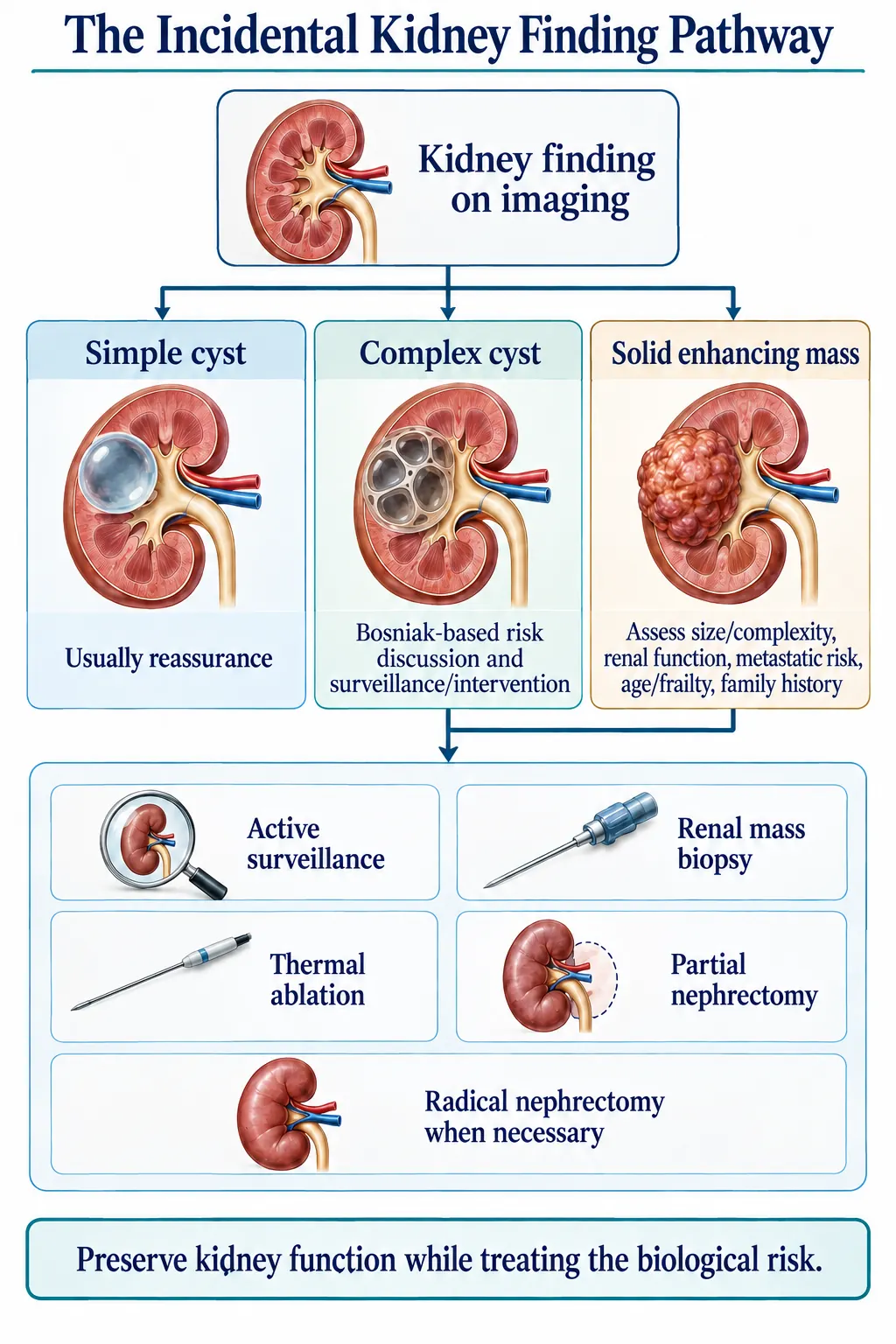
- Ask for the finding to be named precisely: simple cyst, complex cyst, solid enhancing mass or indeterminate lesion.
- Simple kidney cysts are extremely common and usually need no treatment.
- Even among small solid masses, biology varies, and some can be observed safely in selected patients.
- A kidney mass biopsy is most useful when its result can change management; a nondiagnostic biopsy does not prove a mass is benign.
- Partial nephrectomy preserves kidney tissue and is prioritized for many small localized masses.
- Active surveillance is structured imaging and reassessment, not denial.
An incidental finding is not an automatic emergency
Kidney findings are often discovered on a scan done for another reason. The word mass describes something visible. It does not say whether the finding is benign, malignant, aggressive or in need of immediate treatment. The first step is to ask for the finding to be named precisely: a simple cyst, a complex cyst, a solid enhancing mass or an indeterminate lesion. Then ask what additional imaging or a biopsy would change.
Cysts and solid masses are different
- Simple cysts are extremely common and usually need no treatment. In most cases the finding calls for reassurance.
- Complex cysts are categorized by imaging features that estimate the risk of cancer. That category, commonly expressed with the Bosniak system, guides a discussion of surveillance or intervention.
- Solid enhancing masses take up contrast on imaging and deserve a different workup. Even among small kidney masses, biology varies, and some can be observed safely in selected patients.
High-quality contrast imaging helps characterize enhancement, anatomy and complexity. Kidney function and protein in the urine affect both the choice of imaging and the consequences of treatment. Young age, masses in both kidneys or multiple masses, or a suggestive family history may lead to genetic counseling.
When a biopsy helps
A kidney mass biopsy is useful when its result can change management. That includes selected decisions about surveillance and ablation, and situations in which a mass might be a spread from another cancer, an inflammatory or infectious process, or a blood-related disease. A nondiagnostic biopsy does not prove a mass is benign. A biopsy may add little when a healthy person has already chosen definitive surgery, or when a frail person will be observed regardless of the result.
Comparing the options
When treatment is indicated, the choice weighs cancer control against how much healthy kidney will remain.
- Active surveillance means structured imaging and reassessment when competing health risks or slow-growing behavior justify it. It is not denial.
- Thermal ablation can provide local treatment with less operative burden for selected tumors.
- Partial nephrectomy removes the tumor while preserving the rest of the kidney. It is prioritized for many small localized masses, especially when kidney reserve is limited.
- Radical nephrectomy, removal of the whole kidney, remains appropriate when tumor complexity, cancer safety or the expected function of the remaining kidney makes it the better choice.
Two questions frame the decision: what is the risk of the mass, and what is the cost to the kidney of treating it? Removing more kidney than necessary can create long-term consequences. Delaying treatment of an aggressive tumor can do the same. The correct balance is specific to you.
Growth is information, not biology by itself
Surveillance follows size, imaging features and growth. A small change between scans may reflect differences in measurement technique rather than true acceleration. On the other hand, slow growth does not guarantee that a mass is benign. The value of serial imaging is that it adds behavior to the first anatomical snapshot while leaving room to intervene if the balance changes.
A surveillance plan should specify the type of imaging, the interval, the clinician responsible and the finding that would prompt a biopsy or treatment. Without those elements, observation can quietly become loss to follow-up. If you are being watched, make sure you know when your next scan is due and who will review it.
Kidney preservation begins before the operation
The relevant baseline includes the function of both kidneys, protein in the urine, blood pressure, diabetes, vascular disease, prior stones or obstruction, and the amount of healthy tissue likely to remain after treatment. A mass that is technically removable may still call for a different strategy in someone with only one kidney or limited kidney reserve.
After treatment, pathology, kidney function, blood pressure and surveillance remain connected. Cancer control is not the only outcome worth measuring. Preserving enough functioning kidney for your future is part of a successful cancer outcome, because the kidney is both an organ that can contain a mass and an organ whose function affects the health of the entire body.
What to bring to the conversation
Bring the actual imaging and reports, not just a summary, along with prior scans for comparison, recent kidney-function tests and urine results, and your family history. Ask how certain the imaging classification is, whether a biopsy result would change the plan, and how each option would affect both cancer control and your long-term kidney function.
Questions to ask your urologist
- Is this a simple cyst, a complex cyst, a solid enhancing mass or an indeterminate lesion?
- How certain is the imaging classification, and would more imaging change it?
- Would a biopsy result change the plan?
- How do surveillance, ablation, partial nephrectomy and radical nephrectomy compare for cancer control and kidney function in my case?
- If we watch it, what scan, at what interval, and what finding would prompt treatment?
- Should I have genetic counseling?