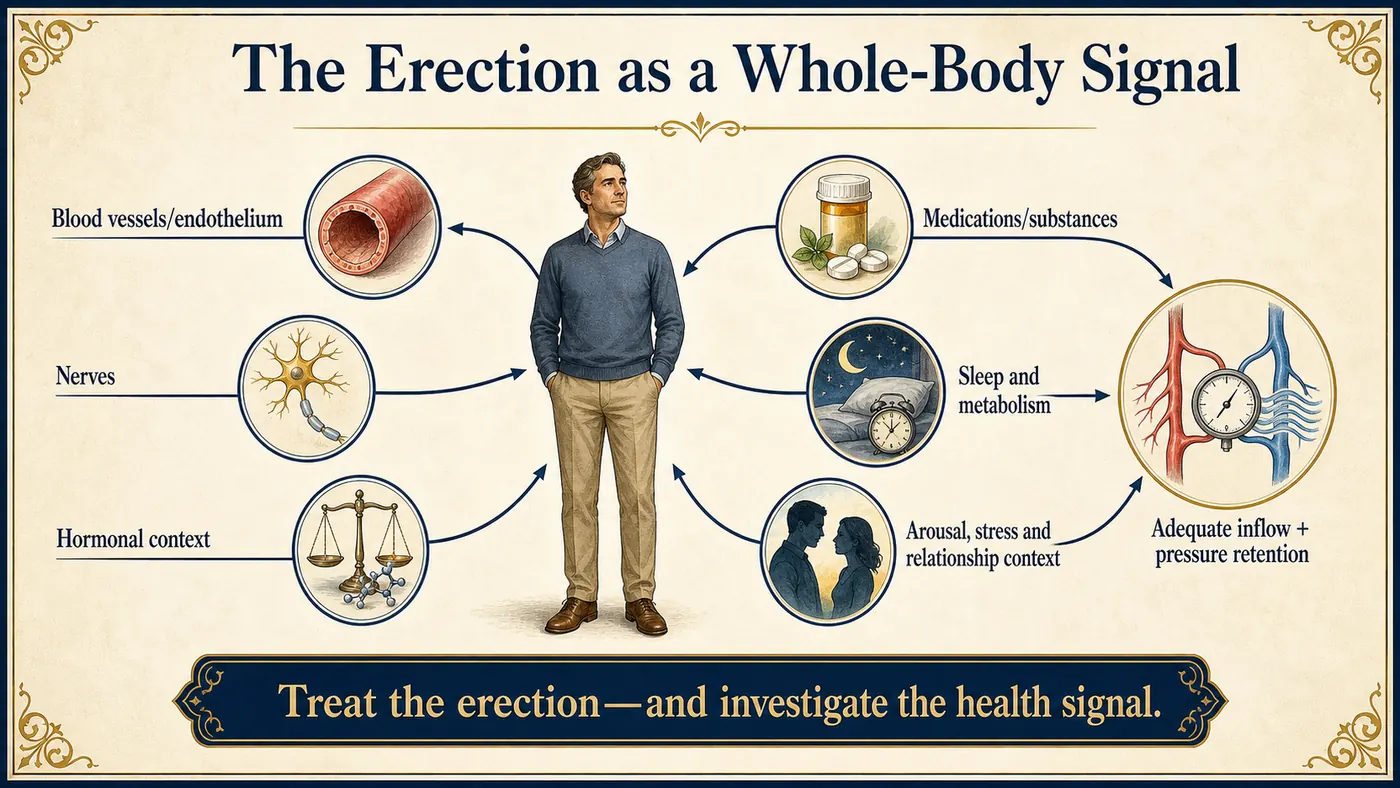
Key points
- ED can be a sexual problem, a relationship problem, a medication effect or an early sign of disease, and often more than one.
- Because the penile arteries are small, vascular problems may show up there before elsewhere.
- How and when erections fail helps separate different causes; describe it as precisely as you can.
- Preserved morning erections are informative but do not prove the problem is purely psychological.
- ED is associated with vascular risk but does not predict an imminent heart attack.
- Success should be defined in your own terms before treatment begins.
A vascular event with a personal meaning
Erectile dysfunction can be a sexual problem, a relationship problem, a medication effect, or an early sign of vascular, metabolic, neurologic or hormonal disease. Often it is more than one. A man may come in wanting a stronger pill after a year or more of less reliable erections, assuming age is to blame, while also carrying a growing waistline, untreated high blood pressure, poor sleep and no recent heart check. The prescription matters. So does the warning.
An erection needs blood to flow in, blood to be kept from flowing out, intact nerves, responsive smooth muscle, adequate hormonal support and psychological readiness for arousal. A disruption anywhere in that chain can reduce rigidity or staying power. Because the penile arteries are relatively small, vascular dysfunction may become noticeable there before it causes more obvious symptoms elsewhere. That is why a change in erections can be worth paying attention to, not just treating.
The timeline separates different problems
Gradual loss of rigidity in every setting usually suggests a different process from sudden difficulty after one distressing sexual experience. Trouble getting an erection differs from losing it during sex. Difficulty in one situation differs from steady loss across all of them. A progressive decline in morning erections, exercise tolerance or response to medication may strengthen concern about whole-body contributors.
Morning or self-stimulated erections are informative. They show that the vascular and nerve systems can still produce an erection under some conditions. But they do not prove the problem is purely psychological.
Describe the failure as precisely as you can
Does the penis become firm and then lose pressure? Does it never become fully rigid? Does it need more and more intense stimulation? These descriptions are imperfect, but they help separate problems of blood inflow, holding pressure, arousal, sensation, medication and anxiety. You are not being asked to diagnose your own anatomy, only to define the problem precisely enough to choose the next useful step.
Desire, orgasm, ejaculation, curvature, pain, fertility plans, medications, substance use and your relationship all belong in the same history. A change in one of these may be the clue that explains the others.
What can contribute
Diabetes, high blood pressure, abnormal cholesterol, smoking, obesity, inactivity, sleep apnea, heart disease, pelvic surgery, radiation, neurologic disease, depression and many medications can all play a part. The assessment includes blood pressure and metabolic risk, a morning total testosterone measurement and other tests selected for you. A low testosterone result needs confirmation before deficiency is diagnosed. Specialized vascular or nerve testing is reserved for cases in which it will change treatment.
Body and mind are not either-or
Psychological contributors are not imaginary causes. Performance anxiety switches on a physiology that works against erection. After one failure, fear of another can become part of the mechanism, even when the original trigger was vascular or a medication. Treatment works better when the biological and psychological parts are allowed to coexist, rather than forcing a choice between “physical” and “in your head.”
A proportionate heart conversation
ED is associated with vascular risk, but it is not a prediction that a heart attack is imminent. The right response is a review of blood pressure, glucose, cholesterol, smoking, weight, physical activity, sleep apnea, family history, symptoms with exertion and whether your preventive care is current. For a man without unstable symptoms, that review is an opportunity to improve both sexual and long-term health. For someone with chest discomfort, marked shortness of breath, fainting or uncertain exercise safety, heart evaluation may need to come before treatment. The erection becomes a reason to ask better health questions, not a diagnosis of heart disease by itself.
A broader workup is also warranted with an abrupt change, penile injury, pain, curvature, loss of libido, new neurologic symptoms, or ED in someone with substantial cardiovascular risk.
Two similar complaints, different questions
One man’s erections change slowly after years of diabetes, high blood pressure, poor sleep and little exercise. Another notices an abrupt change after pelvic surgery. Both deserve treatment, but the questions differ. The first pattern points to blood vessels and metabolism. The second puts anatomy, nerves, recovery and rehabilitation at the front of the discussion. Neither man should be told the problem is simply age or stress.
Success in your own words
Some men want spontaneous intercourse. Others want dependable rigidity even if planning is needed. Some care most about keeping the erection; others about confidence after cancer treatment. A partner may value communication and predictability more than maximum hardness. A symptom score cannot fully define success, so it helps to set a baseline, agree on the functional goal and decide how you will recognize improvement. When the endpoint is clear, treatment is easier to judge and less likely to drift from one disappointing trial to the next.
ED is never “just aging” or “just in your head.” It is a legitimate quality-of-life concern and sometimes an early health signal. The most useful visit addresses reliable sexual function while also looking for treatable vascular, metabolic, sleep, medication, hormonal and emotional contributors.
Questions to ask your urologist
- Could my erection problem signal vascular, metabolic, hormonal, neurologic or medication-related disease?
- Does the way my erections fail point toward a particular cause?
- Which baseline tests are appropriate for me, including a morning testosterone level?
- Do I need a heart evaluation before starting treatment?
- Which first treatment best fits my health and goals safely?